


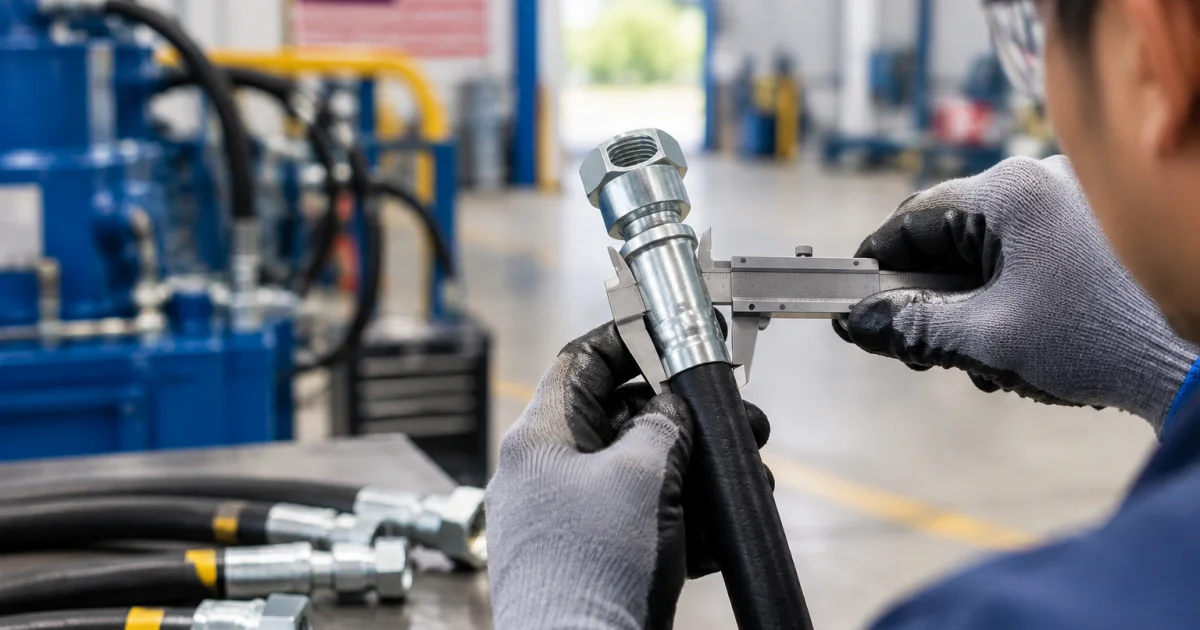
Hydraulic leaks in the field are often blamed on installation error or “operator handling.” Sometimes that’s true. But in my view, many repeat failures start earlier—at the sourcing decision—when buyers treat hydraulic hose fittings like interchangeable hardware rather than a controlled system with tolerances, compatibility limits, and verification steps.
If you’re buying for uptime and safety, the uncomfortable reality is this: a fitting that looks correct on the bench can still fail under pulsation, heat, vibration, chemical exposure, or offshore corrosion. And when it fails, the cost is never the fitting price—it’s the oil loss, clean-up, unplanned stop, manpower, damaged components, and the credibility hit when the same line leaks again after “replacement.”
This article is written for Maintenance & Engineering teams, EPCC procurement, and OEM machine builders who source Hydraulic Hose Fitting Malaysia supply for industrial equipment. It’s an opinionated, buyer-side breakdown of where sourcing goes wrong—and what you should demand from suppliers before you accept a quotation, approve a substitution, or release a hose assembly to site.
Why sourcing fails: buyers purchase a “part,” but operate a “joint”
A hydraulic connection is a joint made of multiple interacting elements: fitting geometry, sealing method, hose construction, crimp spec, ferrule selection, assembly tooling, port condition, and installation practice. When a buyer sources a fitting as a standalone SKU, the system assumptions stay hidden.
Common failure patterns I see repeatedly:
- Wrong sealing method for the port (e.g., mixing 37° flare concepts with other seat types, or relying on thread sealant where the seal should be metal-to-metal or elastomeric at the seat).
- Material mismatch where the fitting survives, but the interface doesn’t (galvanic corrosion, seized threads, or accelerated pitting in aggressive environments).
- Assembly mismatch where the fitting is correct, but the crimp/ferrule/hose combo isn’t qualified together.
- “Equivalent” substitutions that match thread size but not tolerances, seat geometry, pressure rating, or plating performance.
- Uncontrolled cleanliness and handling that introduces particles, damages seats, or nicks sealing surfaces during storage and transport.
In other words: the procurement event is about a line item; the failure event is about an interface. Buyers who treat fittings as commodity items unknowingly accept interface risk.
The real root causes behind field failures (and how they hide in quotations)
Most supplier quotations focus on quantity, unit price, and delivery. But the failure causes hide in what’s not stated: material grade, plating, standards reference, inspection method, traceability, and whether the supplier will support verification when something doesn’t match your port or hose.
1) “Same thread” is not “same seal”
Two fittings can share the same thread designation yet seal differently. If the supplier only confirms thread type and size, you still don’t know whether the seat and sealing method match your ports, adapters, manifold blocks, or valves. The result is a connection that tightens but doesn’t seal reliably—especially under pressure cycling.
What buyers should demand: confirmation of the sealing method (seat type), mating port requirement, and any assembly torque guidance or installation notes relevant to that sealing method.
2) Material and corrosion performance are often assumed
Malaysia’s industrial environments range from indoor manufacturing to coastal plants, offshore operations, washdown areas, and chemical exposure. If a supplier proposes carbon steel with standard plating for a corrosive area (or the wrong stainless grade for the media), your “saving” becomes seized threads, rust bloom, and premature leakage after maintenance.
What buyers should demand: explicit material callout (e.g., carbon steel vs stainless steel), surface treatment/plating specification where applicable, and a clear statement of suitability for the environment (not a guarantee—just technical relevance). If you require stainless steel hydraulic hose fittings, state it early and require the supplier to list the offered alloy and any traceability documentation available.
3) Hose, ferrule, and fitting compatibility is treated as optional
A frequent sourcing mistake is splitting responsibility: you buy hose from one place, fittings from another, and crimping from a third—then hope everything “fits.” The hidden issue is that hose assemblies are qualified as combinations (hose type + fitting series + ferrule + crimp diameter/range + tooling). When that chain is broken, the assembly can pass a quick pressure test and still fail later by pull-off, weeping, or fatigue cracking.
What buyers should demand: written confirmation of compatibility for the intended hose type and pressure class, plus the crimp specification method that will be used (target crimp diameter/range, tooling family, inspection approach). If your supplier can’t discuss crimp verification, you’re buying a gamble.
4) Substitutions are pushed through without engineering sign-off
When lead times tighten, “equivalents” appear. The dangerous version of “equivalent” is: same nominal thread, similar appearance, unknown tolerances, and unclear standards reference. In critical hydraulic lines—especially high pressure hose fitting applications—small geometry differences become leak paths or stress raisers under pulsation.
What buyers should demand: a substitution rule: no alternates without datasheet/standard reference, material equivalency confirmation, and written approval from your engineering/maintenance authority. Procurement should not be forced to approve technical risk under time pressure.
What to demand from suppliers: a buyer’s checklist that actually prevents rework
The goal isn’t to create paperwork. The goal is to force the supplier conversation onto the points that predict field performance. Below is a practical demand list you can include in RFQs, frame agreements, or vendor qualification—especially if you are sourcing hydraulic hose & fittings for uptime-critical assets.
Commercial terms that protect operations
- Clear item definition: fitting series/type, size, end forms on both sides (if an adapter), seal type, and application notes.
- Batch/lot traceability (where available): at minimum, packaging identification; ideally, lot number and manufacturer reference for critical circuits.
- Controlled substitutions: no changes without prior written approval and technical data provided.
- Packaging expectations: protective caps/plugs for contamination control; corrosion protection suitable for storage conditions.
Technical proof points buyers can verify quickly
- Standards alignment: supplier states which recognized standard or manufacturer specification the fitting series is built to (even if you don’t need the full document).
- Material and finish stated on the quotation: don’t accept “steel” with no definition.
- Dimensional verification approach: how the supplier checks seat geometry and critical dimensions (sampling is acceptable if stated).
- Assembly QA (if buying assemblies): crimp diameter check method, cleanliness approach, and labeling.
Support you will need when something doesn’t match
Even strong drawings and part numbers won’t eliminate surprises: worn ports, mixed legacy standards, undocumented modifications, or last-minute routing changes. The best suppliers don’t just ship; they help you de-risk decisions when reality deviates from paper.
What buyers should demand: responsive technical support, basic troubleshooting guidance, and the ability to help identify the correct connection type from photos, samples, or on-site checks when needed (especially during shutdown windows).
A practical comparison table: supplier promises vs buyer-proof requirements
Use this table as a quick “red flag filter” during sourcing. If a supplier can’t meet the right-hand column for your critical lines, you’re likely to see repeat leaks or rework.
| Supplier claim on quote | What it often really means | What buyers should demand (verifiable) |
|---|---|---|
| “Hydraulic fitting, same size” | Thread size matches; sealing method may not | Seat/seal type confirmation + mating port requirement |
| “Equivalent brand / compatible” | Visual similarity; unknown tolerances/series | Datasheet/series reference + substitution approval workflow |
| “Stainless” | Unspecified alloy; may be wrong for corrosion/media | Alloy grade stated + traceability evidence for critical use |
| “Complete hose & fitting set” | Parts bundled; assembly qualification unclear | Hose/fitting/ferrule compatibility confirmation + crimp spec method |
| “High pressure” | Marketing term; pressure rating may be missing context | Pressure rating context (series and size) + application limits discussion |
| “Ready stock” | Fast delivery; storage/handling unknown | Capped/plugged ends + packaging suitable for contamination control |
How to qualify a hydraulic hose fitting supplier in Malaysia (without making procurement impossible)
Qualification doesn’t have to be slow. You can run a lightweight process that still catches the high-risk gaps. Here is a pragmatic approach that balances procurement speed and engineering control.
Step 1: Classify circuits by consequence
Not every line needs the same scrutiny. Create two or three consequence tiers:
- Critical: safety exposure, high pressure, hot surfaces, offshore/corrosive, environmentally sensitive, or major production impact.
- Standard: typical industrial hydraulics with manageable downtime.
- Non-critical: low consequence, easy to isolate, minimal spill risk.
Then apply your strictest sourcing demands only to critical lines. This avoids over-processing low-risk buys while protecting the lines that keep you awake at night.
Step 2: Require “fit-for-interface” evidence on critical lines
For critical circuits, ask for interface-specific confirmation: seal type compatibility, material/finish suitability, and assembly/QA approach if hose assemblies are supplied. This is especially important when you have mixed equipment vintages or imported machinery with non-standard documentation.
Step 3: Audit the supplier’s failure-handling process
Failures will happen. The question is whether the supplier helps you contain them. Ask what information they need to troubleshoot (photos, mating port details, operating pressure/temperature, media, installation notes) and how they handle suspected wrong selection or defect investigation.
A supplier that can only say “send back the part” without asking technical questions is unlikely to prevent recurrence.
Step 4: Prefer suppliers who can cover adjacent needs
In practice, buyers often search for “hose & fitting” solutions because they need the interface controlled end-to-end—selection, compatibility, assembly, and availability. Suppliers who also support connectors, instrumentation products, stainless steel tubing, and on-site troubleshooting can reduce the handoff gaps that create repeat leaks.
Useful next steps (related products)
- Hydraulic hose fittings product range
- Connectors and fittings for fluid connections
- Autoclave fittings for high-pressure applications
Conclusion: buy less uncertainty, not just a lower unit price
My view is that sourcing failures aren’t mainly caused by “bad fittings.” They’re caused by buyers being forced into decisions without the information needed to protect the interface: seal type, compatibility, material/finish suitability, traceability, and assembly QA discipline.
When you tighten your supplier demands—especially on critical circuits—you’re not adding bureaucracy. You’re removing uncertainty. And in hydraulic systems, uncertainty shows up as leaks, downtime.
Frequently Asked Questions
What information should I provide when requesting a quotation for hydraulic hose fittings?
Provide end connection types (including seal/seat style), size, pressure range, environment (corrosion/chemical exposure), hose type if applicable, and whether substitutions are allowed. If you can, include photos of the mating port and existing fitting to avoid “same thread, different seal” mistakes.
How do I tell if a supplier’s “equivalent” hydraulic fitting is truly compatible?
Don’t accept equivalence based only on thread size. Ask for the fitting series reference or datasheet, confirm the sealing method and mating port requirements, and ensure the material/finish matches your environment. For critical lines, require engineering approval before any substitute is shipped.
Why do hose assemblies fail even when the fitting and hose seem correct?
Because the risk often sits in the combination: hose construction, ferrule selection, crimp diameter range, tooling condition, and inspection method. A bench-tight assembly may still fail under pulsation or heat if the hose/fitting/ferrule set was never validated together or the crimp wasn’t verified.
When should I specify stainless steel hydraulic hose fittings in Malaysia?
Consider stainless steel for corrosive or washdown environments, coastal/offshore exposure, or where rust contamination and seized threads create maintenance risk. Specify the alloy grade and request traceability evidence for critical circuits so “stainless” doesn’t become an undefined label.
What should I demand from hydraulic hose fitting suppliers to reduce repeat leaks?
Demand clarity on seal type and port compatibility, explicit material/finish on the quote, controlled substitutions, protective packaging to prevent contamination, and a stated QA approach for assemblies (crimp verification and cleanliness). Also value suppliers who can support troubleshooting when real-world ports or legacy equipment differ from drawings.
Need a supplier who treats fittings as a critical interface?
Inland supports Malaysian maintenance teams, EPCC buyers, and OEM builders with hydraulic hoses and fittings, connectors, and engineered solutions—backed by over 30 years of industry experience. If you want fewer surprises on-site, talk to our team about selecting the right fitting series, material, and assembly approach for your environment and duty cycle.