


Accurate liquid level measurement is essential for maintaining safe and efficient operations in industries such as oil and gas, petrochemical, chemical processing, and power generation. In these environments, storage tanks, pressure vessels, and process equipment often contain hazardous, corrosive, or high-pressure fluids that require reliable monitoring solutions.
Traditional level measurement methods may face challenges when operating under extreme conditions, especially where safety, visibility, and maintenance accessibility are critical. This is why many industrial facilities choose magnetic level gauges as a dependable solution for monitoring liquid levels without direct contact with the process fluid.
Designed for demanding applications, magnetic level gauges provide clear visual indication, improved safety, and reliable performance in hazardous environments. Understanding their advantages can help engineers and facility operators select the right level measurement solution for their industrial systems.
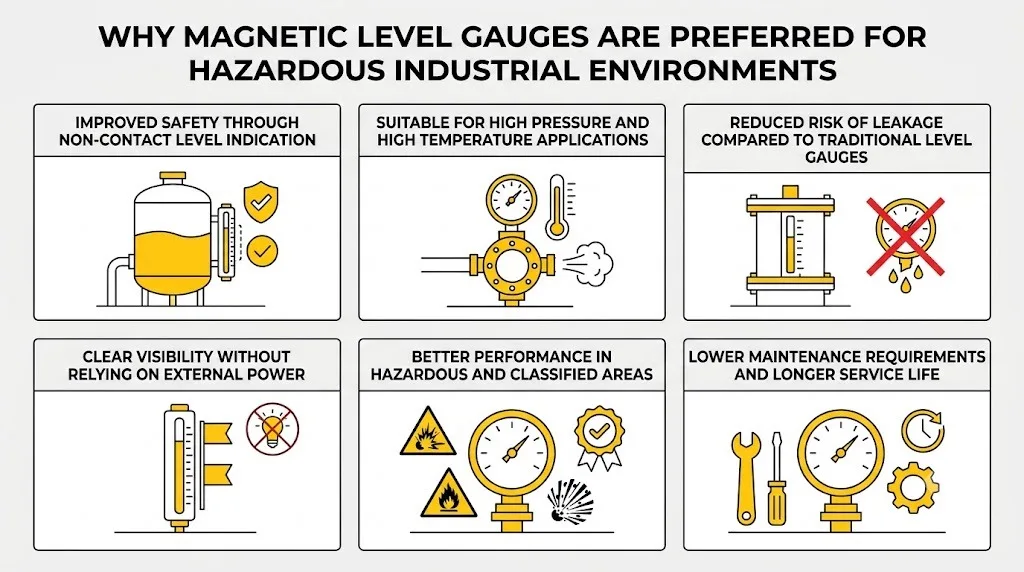
1. Improved Safety Through Non-Contact Level Indication
One of the main reasons magnetic level gauges are preferred in hazardous environments is their ability to provide level indication without direct exposure to process fluids.
Unlike traditional glass tube level gauges, magnetic level gauges use a float with an internal magnet that moves according to the liquid level. The magnetic field transfers the float position to an external indicator, allowing operators to view the liquid level without opening the system or coming into contact with the process medium.
This design reduces the risk of exposure to:
- Toxic chemicals
- Flammable liquids
- High-temperature fluids
- Pressurised process media
For industries handling hazardous substances, reducing operator exposure is an important factor in improving workplace safety.
2. Suitable for High Pressure and High Temperature Applications
Industrial environments often involve extreme operating conditions where standard level measurement devices may not perform effectively.
Magnetic level gauges are designed to withstand demanding conditions, including:
- High operating pressure
- Elevated temperatures
- Corrosive process fluids
- Continuous industrial operation
Their robust construction makes them suitable for applications such as storage tanks, separators, boilers, and process vessels.
By selecting a level gauge with the correct pressure rating, material compatibility, and temperature capability, industries can achieve more reliable measurement performance while reducing the risk of equipment failure.
3. Reduced Risk of Leakage Compared to Traditional Level Gauges
Leakage is a major concern in hazardous industrial facilities, especially when handling chemicals, hydrocarbons, or other dangerous fluids.
Traditional glass level gauges may require direct contact points between the measurement chamber and viewing components, creating potential leakage risks if glass tubes are damaged or seals deteriorate.
Magnetic level gauges minimise these risks through a sealed chamber design. Since the liquid remains contained inside the gauge body while the external indicator displays the level, operators can monitor fluid levels without exposing the process medium.
This helps improve plant safety and reduces the possibility of environmental contamination.
4. Clear Visibility Without Relying on External Power
Another advantage of magnetic level gauges is their ability to provide continuous visual level indication without requiring electrical power.
The external indicator typically uses magnetic flippers or rollers that change position according to the float movement inside the chamber. This allows operators to quickly identify liquid levels from a distance.
Benefits include:
- Easy monitoring during routine inspections
- Operation during power interruptions
- Reduced dependence on electronic systems
- Simple visual confirmation of tank levels
For hazardous areas where electrical equipment requirements are strict, this passive indication method can provide additional reliability.
5. Better Performance in Hazardous and Classified Areas
Many industrial facilities operate in hazardous zones where equipment must meet strict safety requirements due to the presence of flammable gases, vapours, or combustible materials.
Magnetic level gauges are commonly selected for these applications because they can provide mechanical level indication without requiring complex electrical components at the measurement point.
They are widely used in industries such as:
- Oil and gas processing
- Petrochemical plants
- Chemical manufacturing
- Power generation facilities
- Marine and offshore applications
Choosing the appropriate level measurement equipment helps companies maintain compliance with safety requirements while ensuring reliable operation.
6. Lower Maintenance Requirements and Longer Service Life
Maintenance efficiency is an important consideration for industrial operators. Equipment failures can result in production interruptions, increased repair costs, and safety concerns.
Magnetic level gauges generally require less maintenance compared to some conventional level measurement devices because they have fewer moving external components and no direct viewing glass exposed to process conditions.
Regular inspections usually focus on:
- Checking float movement
- Inspecting connections
- Ensuring indicator visibility
- Verifying measurement accuracy
With proper installation and maintenance, magnetic level gauges can provide long-term performance in demanding industrial environments.
Choosing the Right Magnetic Level Gauge for Industrial Applications
Although magnetic level gauges offer many advantages, selecting the correct model is essential to ensure reliable measurement performance and long-term operation. Engineers need to evaluate factors such as fluid characteristics, material compatibility, operating pressure, temperature conditions, tank or vessel dimensions, connection requirements, and relevant industry safety standards before choosing a suitable solution.
For critical industrial applications, partnering with an experienced instrumentation supplier can help ensure the selected equipment meets specific operational requirements. Reliable solutions such as Weka Level Gauge products are designed to provide accurate level monitoring, durability, and dependable performance in challenging environments across industries such as oil and gas, petrochemical, and power generation.
Conclusion
Magnetic level gauges have become a preferred choice for hazardous industrial environments due to their safety advantages, reliable performance, and ability to operate under demanding conditions. By providing clear level indication without direct exposure to process fluids, they help reduce operational risks while improving monitoring efficiency.
For oil and gas, petrochemical, and power industries, selecting the right level measurement equipment ensures safe and reliable operations. Inland provides industrial instrumentation solutions, including reliable level measurement products, to support demanding applications across Malaysia. Contact Inland today to find the suitable Weka Level Gauge solution for your process requirements.
About the Author

The Inland Technical Insights Team draws on three decades of experience in servicing the oil, gas, petrochemical, power-plant, and instrumentation sectors in Malaysia and Southeast Asia. Founded in 1995 and licensed by national authorities, Inland provides not only premium stainless-steel tubing and instrumentation components but also engineering support, on-site fabrication, and system design services.
Frequently Asked Questions
Why are magnetic level gauges preferred in hazardous industrial environments?
Magnetic level gauges provide safe, non-contact visual level indication while keeping the process fluid sealed inside the chamber. This design reduces the risk of leaks and operator exposure, making them suitable for hazardous industrial applications.
Can magnetic level gauges be used with corrosive liquids?
Yes. Magnetic level gauges can be manufactured using corrosion-resistant materials such as stainless steel or specialised alloys, making them suitable for many corrosive chemicals and aggressive process fluids.
Are magnetic level gauges suitable for outdoor installations?
Yes. Magnetic level gauges are commonly installed outdoors in industrial plants. Their robust construction allows them to perform reliably in harsh weather conditions, including rain, heat, and dusty environments.
What types of tanks can use magnetic level gauges?
Magnetic level gauges are suitable for storage tanks, pressure vessels, boilers, separators, reactors, and other industrial process equipment where continuous liquid level monitoring is required.
What is the difference between a magnetic level gauge and a glass level gauge?
A magnetic level gauge uses a sealed chamber and external magnetic indicator to display liquid levels, while a glass level gauge relies on direct visual observation through a transparent tube or window. Magnetic level gauges generally offer better protection for hazardous or high-pressure applications.